Last Updated: November 13, 2026
Quick Summary
The best men haircut styles for business are classic cuts like the side part, traditional taper, and Ivy League, plus short options such as a low taper fade with two to three inches on top. These styles stay neat through the workweek, suit your face shape, and match your office dress code.
- A taper shortens hair gradually at the neckline and sideburns, while a fade blends all the way up to the top.
- High fades grow out visibly within two weeks, so formal workplaces should keep the fade low.
- Guard numbers run from 0 to 8, and each number is roughly one-eighth of an inch of length.
- Bring two reference photos, one for the sides and one for the top, to your barber.
- Book your next appointment at the end of each visit rather than waiting until the cut looks tired.
Table of Contents
- What Makes a Haircut Work for the Office
- Classic Business Haircuts That Never Miss
- Short Professional Haircuts Male Professionals Rely On
- Matching the Cut to Your Hair Type and Face Shape
- Men Haircut Styles for Business Straight Hair
- The Business Haircut With Beard: Pairing Facial Hair and a Sharp Cut
- A Business Haircut for Men With a Receding Hairline
- How to Ask Your Barber for Exactly What You Want
- Keeping the Cut Sharp Between Appointments
- Book Your Next Business Cut With Fernando’s Legacy
- Frequently Asked Questions
What Makes a Haircut Work for the Office
A business haircut succeeds when it stays neat for the length of a workweek, suits your face shape, and matches the dress code of the room you walk into. When men look for haircut styles for business, they are usually chasing the same three things: a clean silhouette, low daily effort, and a cut that doesn’t look dated by Friday.
The difference between a sharp office look and a forgettable one rarely comes down to the trendiest style. It comes down to proportion, maintenance, and how honestly you describe your routine to your barber.
Here’s the good news: the styles that work hardest in professional settings are also the easiest to maintain. Below, we’ll break down the classic cuts, the modern options, and exactly how to ask for each one.
The core tension in this whole category is simple. A haircut can look excellent in the chair and fall apart by day ten if the shape wasn’t built for your hair type or your calendar. Every recommendation in this guide is filtered through that reality.
Classic Business Haircuts That Never Miss
Classic cuts win in professional settings because their shape is predictable. A barber can replicate them appointment after appointment, and you can style them in under two minutes.
The Side Part and Traditional Taper
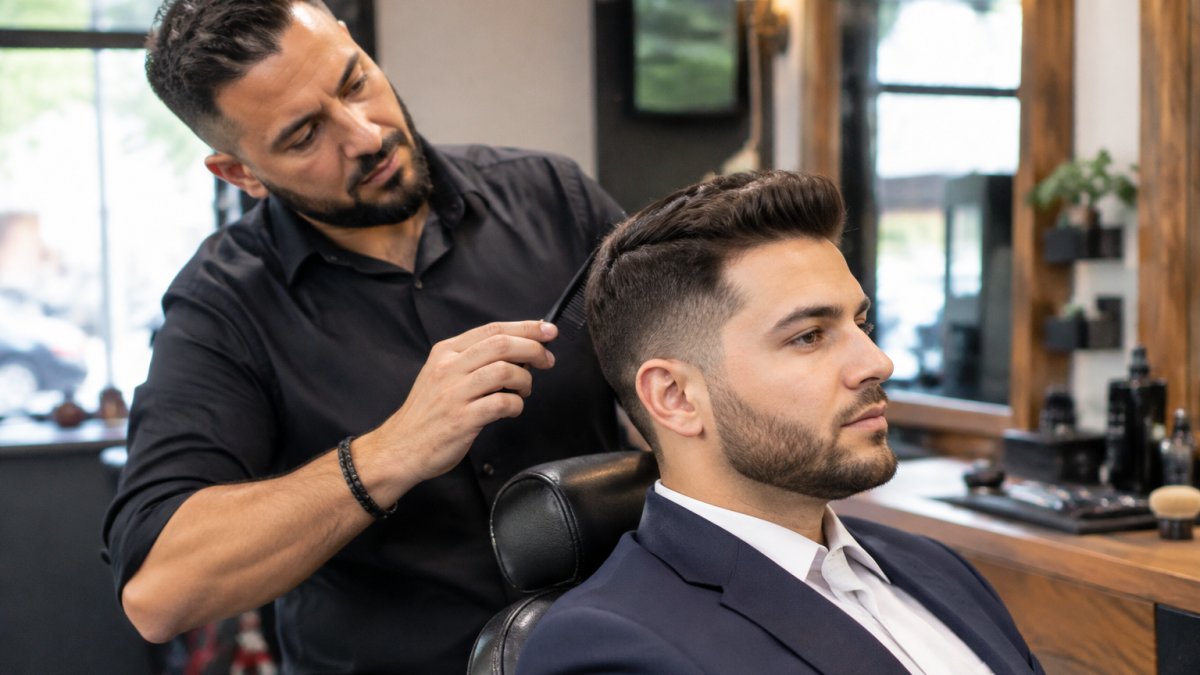
The side part is the safest professional hairstyle in existence. Hair is combed to one side with a defined part, while the back and sides are tapered gradually rather than clipped to a uniform length. That gradual taper is what separates a traditional taper from a hard fade, and it’s why a side part reads as conservative and polished rather than trendy.
Ask for a part that follows your natural growth pattern. A forced part fights your hair all day and collapses by lunch.
The Ivy League and Regular Haircut
The Ivy League haircut is a short, neatly tapered cut with enough length on top to comb forward or slightly to the side. It sits between a crew cut and a side part, which makes it one of the most flexible short professional haircuts male professionals can wear without thinking about it.
The regular haircut is its cousin: short back and sides, scissors or clipper work blended into a longer top, with a soft feathered edge instead of a hard line. Both are office-friendly haircuts that age well between appointments.
Short Professional Haircuts Male Professionals Rely On
Short cuts dominate business environments because they hold their shape longest. The most dependable options are the Ivy League, the traditional taper, the textured side part, and a low fade with a conservative top.
A common mistake is requesting a high fade in a formal workplace. High fades look sharp, but they grow out visibly within two weeks and can read as more casual than a low taper. If your office leans formal, keep the fade low and the top controlled.
For a modern professional style that still respects a dress code, ask for a taper fade on the back and sides with two to three inches left on top. You get the clean edges of a fade haircut with enough hair on top to style a side sweep, a light quiff, or a simple comb-over.
The buzz cut deserves a mention too. It’s the lowest-maintenance option on this list, but it removes every styling option you have. Choose it only if your workplace is genuinely casual or your hair density is thinning enough that shorter is simply cleaner.
Matching the Cut to Your Hair Type and Face Shape
The right cut for you depends more on hair texture, density, and head shape than on whichever style is trending. A cut that ignores your growth pattern will look wrong no matter how well it’s executed. The same side part can look sharp on one head and sloppy on another purely because of texture and density, so treat the table below as a starting point and the notes after it as the real decision guide.
If you want a deeper walkthrough of proportion and face shape, our guide on how to choose the perfect hairstyle for your face shape breaks down the geometry in detail.
Here’s how we’d sort it:
| Hair Type | Best Business Cuts | What to Avoid |
|---|---|---|
| Straight, fine | Ivy League, regular haircut, textured side part | Long swept-back styles that fall flat |
| Straight, thick | Side part, taper fade, pompadour | Blunt heavy fringes |
| Wavy | Layered cut, tousled style with taper | Tight buzz cuts that expose cowlicks |
| Curly | Tapered sides with shaped top, short curly crop | Aggressive thinning that causes frizz |
| Coily | Rounded taper with a shaped top, short afro with clean edges | One-length clipper cuts that flatten the shape |
| Coarse or dense | Fade haircut with longer top, undercut | One-length clipper cuts |
Straight hair
Straight hair is the most forgiving texture for office cuts, and it’s also the easiest to style badly because it shows every uneven line. Fine straight hair benefits from a layered cut that adds movement without weight; thick straight hair can carry a taper fade with a longer top and a bit of texture worked in. Use a light matte product rather than a heavy pomade, because straight hair carries weight poorly and a high-shine product makes fine hair look thinner.
Wavy hair
Wavy hair holds a side part well but fights a hard line. Ask for a layered cut with a taper on the back and sides so the wave has room to move, and avoid a tight buzz cut if you have cowlicks near the crown or hairline, because the wave will push through and look uneven within days. A soft feathered edge on the top blends better than a blunt cut.
Curly hair
Curly hair needs a barber who cuts it dry or understands how much it will shrink. A tapered side with a shaped top keeps the silhouette clean without shaving off the curl pattern, and a short curly crop works in conservative offices when the edges are kept tidy. Aggressive thinning is the most common mistake: it breaks the curl pattern and creates frizz that no product can fix. Ask for shaping rather than heavy thinning.
Coily hair
Coily hair deserves its own guidance. A rounded taper with a shaped top keeps the outline professional while preserving length where it matters, and a short afro with clean edges reads as sharp in client-facing roles. One-length clipper cuts flatten the shape and make the head look rounder than it is. Find a barber who regularly cuts coily hair rather than assuming any shop can shape it.
Coarse or dense hair
Coarse or dense hair can carry more length on top than finer textures, so a fade with a longer top or an undercut gives you contrast without bulk. The risk is a one-length clipper cut, which turns dense hair into a helmet. Ask for visible graduation between the sides and the top.
Face shape
Face shape matters just as much as texture. Round faces benefit from height on top and tighter sides to add length. Long faces do better with some width at the temples and less vertical volume. Square jawlines can carry almost anything, including a clean buzz cut. Oval faces are the most flexible and can wear a side part, Ivy League, or taper fade without adjustment. If you are between two shapes, favor the cut that adds volume where your face is narrowest.
Watch out: a barber who only asks “how short on the sides” is not asking enough. Tell them your texture, your growth pattern, and how you style at home before they pick up the clippers.
Men Haircut Styles for Business Straight Hair
Straight hair is the most forgiving texture for office cuts, and it’s also the easiest to style badly. The cut needs structure because straight hair shows every uneven line.
For men haircut styles for business straight hair, the strongest choices are the classic side part, the Ivy League, a textured side part, and a medium-length swept-back look if your workplace allows it. Fine straight hair benefits from a layered cut that adds movement without weight. Thick straight hair can handle a taper fade with a longer top and a bit of texture worked in with a styling tutorial from your barber.
Two practical notes from behind the chair. First, straight hair that’s cut too long on top tends to lie flat and look unkempt by midweek. Second, a hard part looks sharp on straight hair but needs weekly cleanup to stay crisp.
Use a light matte product rather than a heavy pomade. Straight hair carries weight poorly, and a high-shine product makes fine hair look thinner.
The Business Haircut With Beard: Pairing Facial Hair and a Sharp Cut
A business haircut with beard works best when the two shapes are balanced rather than competing. Short, defined facial hair pairs well with a taper or fade because both share clean lines. A fuller beard pairs better with a slightly longer top so the silhouette doesn’t collapse.
The mistake we see most often is a sharp fade combined with an unshaped beard. The contrast makes the beard look neglected. Ask your barber to blend the sideburn into the beard line so the transition reads as intentional.
Keep the neckline defined but not shaved too high. A neckline that sits too high looks unnatural as it grows back, and you’ll be back in the chair sooner than you planned. A trimmed mustache with a short beard is one of the most office-safe combinations available.
A Business Haircut for Men With a Receding Hairline
A business haircut for men with receding hairline works by embracing the hairline instead of hiding it. Shorter, tapered sides and a textured top that moves forward or slightly across create a clean shape without drawing attention to the recession.
Three approaches that hold up well:
- The short textured crop. Keep the top short enough that thin areas don’t separate, and add texture so the scalp isn’t the focal point.
- The tapered sides with a side sweep. Leave enough length on top to comb across gently, which softens the hairline without a comb-over effect.
- The close crop or buzz cut. A clean, uniform short cut reads as confident and removes the styling problem entirely.
What doesn’t work is holding onto length at the front to cover the temples. It almost always looks heavier and more obvious than a shorter, honest shape. Tell your barber where your hairline is heading, not just where it is today, so the cut can account for change over time.
How to Ask Your Barber for Exactly What You Want
Clear barber instructions get you a better cut than any photo alone. The most reliable method is to bring a haircut reference photo, name the clipper guard numbers for the back and sides, and describe how much length you want off the top in inches. Many guides show the styles but rarely give you the words, so here is the language to use.
The reference script
Say it in this order and you will cover almost everything a barber needs:
- The overall shape. “I want a classic business cut, tapered on the back and sides with about two inches on top.”
- The sides and back. “A number two guard faded into a number four at the parietal ridge, or a scissor taper if you think that suits my hair better.”
- The top. “Leave two inches on top, point-cut the ends so it has texture, and keep it long enough to comb to the side.”
- The part. “Follow my natural part on the left side and don’t force a hard line.”
- The neckline. “A rounded neckline, not squared off, and don’t shave it too high.”
- The sideburns. “Take the sideburns to mid-ear and blend them into the taper.”
- The finish. “I want a soft feathered edge, not a hard line.”
Clipper guard numbers, in plain terms
Guard numbers run from 0 (stubble) to 8 (one inch), and each number is roughly one-eighth of an inch of length. A number one is about 1/8 inch, a number two is about 1/4 inch, a number three is about 3/8 inch, and a number four is about 1/2 inch. For a conservative business cut, the shortest point on the back and sides is often kept at a number two or higher and blended upward from there. If you want a visible fade, name the shortest guard and the guard you want at the top of the fade, not just “a fade.”
Taper versus fade, in one sentence each
A taper gradually shortens the hair at the neckline and sideburns while leaving the rest of the sides longer; a fade blends all the way up to the top. Tapers grow out more gracefully and read as more conservative, which is why they suit formal workplaces. Fades look sharper on day one but show growth within two weeks.
What to bring and what to say about it
Bring two reference photos: one for the sides and one for the top, because a single photo rarely shows both clearly. Point out what you like about each rather than handing over the phone silently. If you have cowlicks, thinning areas, or a receding hairline, say so before the cut starts, not after. A barber who knows where your hair is heading can build a shape that holds up as your hair changes.
Questions to ask before they start
- “How will this look in three weeks, not just today?”
- “Where will you start the taper, and how high will the fade go?”
- “Will you blend the sideburns into the beard line or leave them separate?”
- “How much styling time will this need each morning?”
- “What product should I use at home, and how much?”
Watch out: describing the finish matters as much as the length. “I want a soft feathered edge, not a hard line” tells your barber more than any measurement, and it is the instruction most often left out.
Keeping the Cut Sharp Between Appointments
Business cuts generally hold their shape for a few weeks, with the neckline and sideburns usually showing wear first. Book your next appointment at the end of each visit rather than waiting until the cut looks tired.
At home, keep the maintenance simple. Wash less often than you think, use a light styling product, and comb the shape back into place each morning rather than restyling from scratch. If you wear a side part, train the part with a comb after washing while the hair is still damp.
For a taper or fade, ask your barber to clean up the neckline between full appointments if your schedule allows it. That single touch-up extends the life of the cut noticeably.
Watch out: over-washing and heavy product build-up flatten fine hair faster than anything else. Rinse thoroughly and skip the pomade on days you don’t need hold.
Book Your Next Business Cut With Fernando’s Legacy
A professional appearance is a habit, not a single appointment. The cut that works for your office is the one you can repeat, maintain, and trust your barber to deliver consistently.
That consistency is what we built Fernando’s Legacy around. Our barbers blend classic techniques with modern precision, from traditional tapers and side parts to sharp contemporary fades, in a calm, community-focused shop where you get one-on-one attention instead of a number in a queue. If you’re ready to lock in a cut that holds its shape through the workweek, browse our services and book your appointment.
Your next business cut shouldn’t be a gamble. At Fernando’s Legacy, we pair time-honored barbering with modern precision, personal attention, and a chair that’s ready when you are. Get started with Fernando’s Legacy and walk into your next meeting looking exactly as sharp as you planned.
Frequently Asked Questions
What is the best haircut for a professional look?
A classic taper or side part with short back and sides and a neat, controlled top is the safest professional choice. It keeps the hairline clean, stays out of the face, and grows out gracefully between appointments. If your office is more relaxed, a low fade or a textured side part works just as well. The key is a clean neckline and edges, since that is what reads as polished in a meeting room.
What should I ask my barber for a business haircut?
Bring a photo and name the clipper guard or length you want on the sides and back, how much length to leave on top, and how you plan to style it. Mention your office dress code and how often you can visit. Ask for a tapered neckline rather than a blocked one if you want a softer grow-out. A good barber will confirm the plan before the first cut so there are no surprises.
Can men wear a fade in a business setting?
Yes, if it is kept conservative. A low or mid taper fade with a neat top looks sharp in most offices and pairs well with a business haircut with beard. High skin fades and hard lines read more casual or barber-culture, which can be fine in creative workplaces but may stand out in formal ones. When in doubt, choose the lower fade and keep the transition blended.
What business haircut works well with a receding hairline?
Shorter, cleaner cuts usually work best: a tapered back and sides with a short, textured top that adds a little volume without drawing attention to the hairline. Avoid heavy, flat fringes that expose thin spots. A skilled barber can shape the front to follow your natural hairline instead of fighting it. Many men also pair a shorter cut with a well-kept beard to balance the face.
How often should I get a business haircut to stay sharp?
Many men find a trim every few weeks keeps the back and sides clean. Short tapers and fades show growth fastest, so plan closer to three weeks if your office is formal. If you cannot make it in, ask your barber for a cut that grows out well and learn a simple at-home routine with a light styling product to keep the top neat in between visits.